
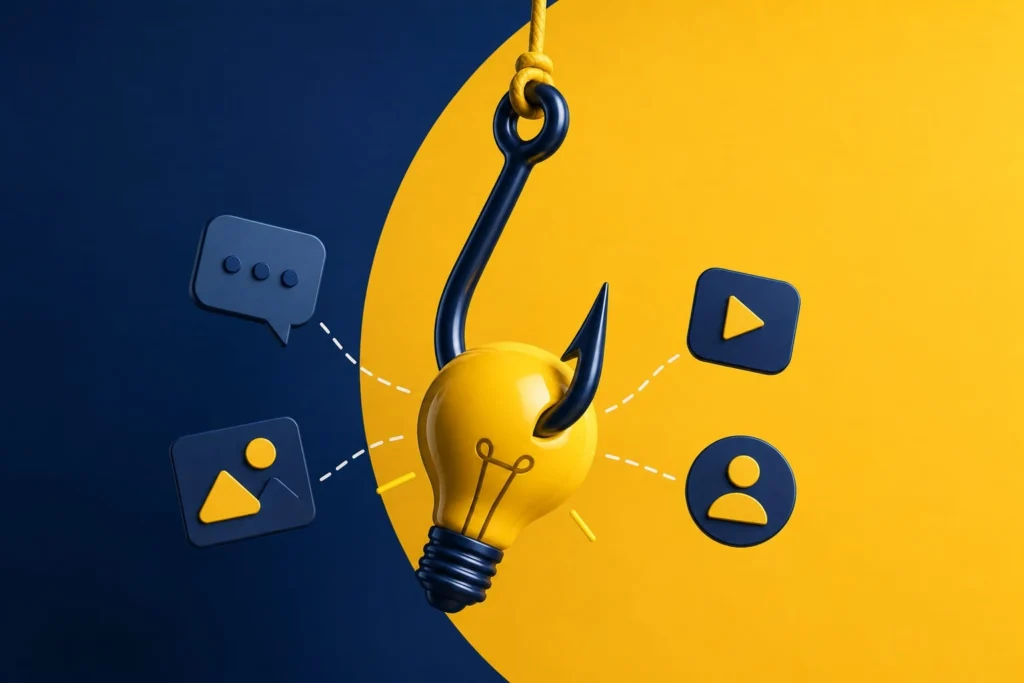
Hook is the first part of any content that has the ability to help people decide if they want to stay and continue interacting or scroll on to the next. There are kinds of hooks like curiosity gap hooks bold claim hooks and pattern-interrupt visual hooks. If you do not have a hook even the valuable content might get ignored. If the hook is not interesting enough people will lose motivation to read the post whether it is a blog or a social media post.
Millions of videos, blogs, advertisements and social media posts are trying to get our attention everyday. The businesses that really stand out in this digital world today are not always the ones that are the loudest but the ones that know how to start things off right. You do not need something big to make an impact on people a simple hook can do the job.
The Psychology of Hooks
People are naturally curious about what’s going to happen next and what we do not know. We want answers, solutions and stories that we can relate to. A strong hook gives us enough information to make us curious without giving too much away. We tend to remember things that’re a little dramatic. For example consider news stories like:
“The biggest mistake brands are still making in marketing.”
“I doubled my engagement after getting rid of this one thing.”
“You are destroying your skin.”
“Five habits that are bad for your health”
Each of these hooks makes us want to keep reading because they point out our insecurities.
Great Hooks Create Emotion
We remember how we feel when we read something. The powerful hooks often make us feel emotions, which makes them more memorable and makes us want to stop and read more. Since peoples attention spans are shorter now it is more important than ever to grab their attention. The best way to do this is to make them feel something, like:
Curiosity
Surprise
Excitement
Compassion
Inspiration
Fear
When people can relate to what you’re saying or feel an emotion they will spend more time on your content.
One Message Many Hooks
You can start the same piece of information in different ways, which can create different moods or emotions. Instead of saying:
“This is how to make your social media better.”
Try saying:
“Your opening is failing, not your content.”
Most people may ignore your content and this is why.
“You have three seconds to grab someones attention.”
The original message is still there. The feelings associated with it change depending on the type of hook used. When people can relate to what you’re saying or feel an emotion they will spend more time on your content.
Hooks Can Look Different
There are types of hooks out there so it is crucial to learn about them what your content needs and how to use them to create the right emotions. Some examples of hooks include:
1. Curiosity Hooks: For example “Did you know there is a social media trick?” makes the reader curious and want to read more.
2. Question Hooks: These are questions that readers might be asking themselves like “Is your social media strategy failing?”
3. Fear or Pain Hooks: These highlight the readers anxiety or suffering like “You’re losing engagement” which triggers a concern that is already there.
4. Statistics Hooks: These provide numbers to make the content more credible like “80% of posts do not reach the target audience” which makes people more likely to trust it.
5. Problem Solving Hooks: These provide a solution to a problem that readers often face like “Can’t rank your content in search results? Here’s why.”
These are a few examples of the different types of hooks that are out there. Notice how different hooks can create emotions and tones so it is crucial to know what type of hook is needed.
Conclusion
You do not need to sensationalise a hook it just needs to be relevent. . The effective hooks are short, personal and clearly explain why something is important. If your audience understands the value and is engaged from the start they are more likely to stay until the end. The first step in marketing is to get peoples attention. People need a reason to stop scrolling before they like, comment, share or make a purchase. If you get the hook right you will get the engagement you deserve.
FAQ
- Why are hooks important in marketing?
We see so much content every day a good hook can make a business stand out stop people from scrolling and make them want to interact with the content.
- Do hooks always have to use fear?
No fear is one possible emotional trigger. Effective hooks can also come from curiosity, enthusiasm, empathy, inspiration, surprise and relatability.
- Can a good hook make bad content successful?
A strong hook can grab attention. It cannot replace valuable information. If the hook is not fulfilled the audience may lose interest. Stop trusting the content.
- What is the important rule when making a hook?
The important rule is to make the hook relevant, to the audience and fulfill its promise. A hook should grab the readers attention. The content that follows should be truly valuable.